
About the Journal
The Indonesian Journal of Gastroenterology, Hepatology and Digestive Endoscopy is the official English-language journal of the The Indonesian Society of Gastroenterology, Indonesian Association for the Study of the Liver, and Indonesian Society for Digestive Endoscopy. The journal is a scientific medical journal dedicated to advancing knowledge and disseminating research in the fields of gastroenterology, hepatology, and digestive endoscopy.
The journal was first published in 1995 under the name Indonesian Forum of Gastroenterology, Hepatology and Digestive Endoscopy. Following improvements in the journal's management and publication system, the journal was renamed The Indonesian Journal of Gastroenterology, Hepatology and Digestive Endoscopy in 2000. The journal carries Print ISSN 1411-4801 and Online ISSN 2302-8181.
The journal publishes peer-reviewed original articles, review articles, and case reports related to gastroenterology, hepatology, and digestive endoscopy. The journal is published three times a year, in April, August, and December, and welcomes contributions from researchers and clinicians in Indonesia and internationally.
Throughout its development, The Indonesian Journal of Gastroenterology, Hepatology and Digestive Endoscopy has continuously strengthened its editorial, peer-review, publication, and ethical standards in accordance with international standards of scholarly publishing. The journal has also contributed to the development of scientific publishing in Indonesia and has supported efforts to improve the quality and international visibility of medical research.
The journal has progressively expanded its visibility through inclusion in Crossref, Directory of Open Access Journals (DOAJ), EBSCO, Google Scholar, Garuda, WorldCat, ROAD, and Dimensions, among other scholarly and bibliographic databases. The journal is also accredited SINTA 2.
A major milestone in the journal's development was achieved in 2026, when The Indonesian Journal of Gastroenterology, Hepatology and Digestive Endoscopy was accepted for coverage in Scopus following evaluation by the Scopus Content Selection & Advisory Board (CSAB). This achievement marks an important step in increasing the journal's international visibility and recognition and reflects its ongoing commitment to editorial quality, publication ethics, and scholarly excellence.
Peer Review Process
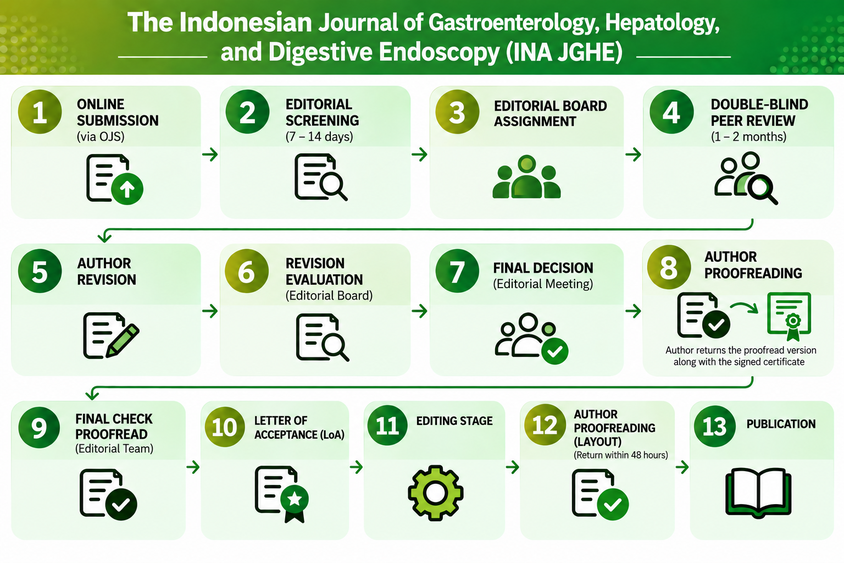
- Submission
All manuscripts must be submitted online through the Open Journal Systems (OJS). Each submission is assigned a unique identification number, and its details are recorded in the journal’s system. The editorial office communicates only with the corresponding author regarding the manuscript status. An acknowledgment of receipt will be sent via e-mail once the submission is received.
Authors are strongly encouraged to ensure that their manuscripts are written in clear and accurate English before submission. Language editing, grammar, style, and formatting should be checked in advance, particularly for revised submissions.
- Screening
Each submitted manuscript is first reviewed by an editor to determine whether it fits the journal’s aims and scope and to identify any significant methodological flaws. Manuscripts that pass this stage undergo plagiarism screening before being sent for peer review.
- Peer Review Process
INA JGHE applies a double-blind peer review process, in which both authors and reviewers remain anonymous. Each manuscript is assigned to Section Editor with expertise in the relevant field. The editor selects at least two reviewers from different institutions (national or international) to ensure objectivity.
Reviewers are expected to provide constructive feedback for both authors and editors. They must treat manuscripts as confidential documents and must not use, share, or reproduce their content. Any potential conflicts of interest must be declared to the editor.
- Decisions
Editorial decisions are based primarily on the originality, scientific quality, and significance of the work, while other considerations include its contribution to existing knowledge, methodological rigor, and overall suitability for INA JGHE. Possible outcomes of the review process include acceptance, acceptance with minor revisions, resubmission for review with major revisions, recommendation to submit elsewhere, or decline. The corresponding author will receive a formal decision letter containing anonymous reviewer comments and editorial recommendations. On average, the time from submission to decision is approximately 3-5 months.
- Appeals Policy
Authors who believe that their manuscript was rejected due to a misunderstanding or an error in the review process may submit an appeal to the editorial office. The appeal will be considered by the Editor-in-Chief, who may consult with the handling editor or members of the editorial board. Possible outcomes of an appeal include upholding the original decision, inviting a revised submission, or assigning the manuscript to a new review process. All decisions resulting from appeals are final.
- Publication
Accepted manuscripts proceed to copyediting and typesetting to ensure consistency with journal style, after which authors will receive proofs of their articles primarily to check typesetting accuracy. Authors are required to return corrected proofs within 48 hours of receipt, as delays may postpone publication.
Publication Frequency
This journal is published three times a year in April, August, and December.
Open Access Policy
This journal provides immediate open access to its content on the principle that making research freely available to the public supports a greater global exchange of knowledge.












